
Key takeaways
- Most successful professionals don't realise their job has quietly become their entire life until the work stops
- For many of us, work provides the social circle, the structure, the identity, and the daily sense of purpose
- When work ends without anything built around it, the silence can be devastating (and sometimes dangerous)
- You don't have to wait for retirement, redundancy, or a health scare to start building a life outside your career
- The quiet pull you've been feeling toward "something more" is often a signal: build a life around your work, not just in it
Who are you when the work ends? It's the question most successful people never ask until it's too late. For a lot of capable, hardworking professionals, the job quietly becomes the life: the social circle, the structure, the identity. When the work ends without anything built around it, the silence can be devastating. Here's why that matters now.
Why does work quietly become your whole life?
Because we don't notice it happening. We tell ourselves we have a life and we have a job. But for many of us, somewhere along the way, the job becomes the life. The social life lives at work. The structure of the day comes from work. The sense of mattering comes from a title and a business card.
Look, here's the thing. You meet someone at a barbecue. They ask what you do. You tell them. They nod. And that's your place in the world handed back to you in one sentence. That feels fine. Right up until the work ends.
For a lot of the women I work with at Your Dream Lab (women in their 50s with twenty, thirty years of corporate experience behind them), this is the quiet realisation. They look at the last week and ask honestly: how much of my social life came through work? How much of my daily structure came through work? When I sat down on Sunday night, was there anything in my week, anything at all, that wasn't tied to the job in some way?
The honest answer for most of them, when they really look, is "not much." They've built a great career. They've got the house, the family, money in the bank. By every external measure, they've won. But when they sit with what they've built outside the office, there's a long silence. And that silence is the thing.
What happens when the job ends and there's nothing there to catch you?
I want to tell you about my dad, because his story changed everything for me.
My dad was the local chemist. He loved his work, he was good at it, and he stood behind that counter for decades. Knew every regular by name. Knew their kids, knew their health, knew their stories. His work was his social life. Customers came in for a script and left having had a proper chat.
But here's the bit nobody warns you about. After hours? Nothing. On weekends? Nothing. We tried for years, my mum and the rest of us, to nudge him toward something outside the shop. A hobby, a club, a sport, a mate to ring up. He just wasn't interested. He was social all day at work, and that was enough for him. By the time he got home, he just wanted to relax. I get it.
Then a couple of young blokes made him an offer for the pharmacy, and he retired a bit earlier than he probably would have. He thought he was going to relax.
Within five years, he was gone.
He was only in his early seventies. Officially, he had a stroke. But the truth I came to understand is simpler than that. When the work ended, the life he'd been living through it ended too. He went home to an empty diary and a quiet weekend that stretched into a quiet year, and there was nothing waiting on the other side to live for. He died, I genuinely believe, of loneliness and boredom.
That's not a story about an old bloke who didn't do enough hobbies. That's a story about anyone whose work has quietly grown into the whole of their life, and who doesn't notice until the work stops.
How do you know if your life is too tangled up with your work?
Honestly? You probably already know. But here are the questions that will tell you for sure.
Look at the last week:
- How much of your social life came through work?
- How much of your daily structure came from work?
- How much of your sense of mattering came from your title?
- Who are the people in your life who wouldn't disappear if the job did?
- If the title came off the door tomorrow, what would actually be there?
If those questions feel uncomfortable, sit with the discomfort. The discomfort isn't a problem. It's information.
And here's something important. By some estimates, around 91% of mid-career professionals report experiencing what's been called "purpose anxiety": a deep, quiet sense that something is missing, even when everything else looks like success. One survey found 72% of women reported burnout in the past 12 months. Nearly three in four are considering a career change. These numbers aren't just statistics. They're the quiet pull you've been feeling. They're the reason you're reading this right now.
This isn't a personal failing. It's a systemic pattern. And it's a signal worth listening to.
Why is now the right time to start, not when you retire?
Because waiting is the most expensive thing you can do.
People wait for the perfect moment. They wait for the company to restructure them out, for the doctor to say something serious, for a partner to leave, for any of the usual brutal alarm clocks that finally make us pay attention. The reality is, you don't have to wait for the crisis. You can wake up now.
Think about this: some research suggests a 50-year-old founder is around 1.8 times more likely to build something successful than someone half their age. You've got the wisdom dividend. You've got the experience. You've got the network. You've got the financial cushion that the 25-year-old doesn't have. The story that says "it's too late" is rubbish. It's never been a better time.
But the bigger point is this. Building a life outside work isn't only about starting a business. It's about creating something that will be there for you when the work isn't. A community. A skill. A practice. A reason to get out of bed on a Tuesday in five years that has nothing to do with what's on your email signature.
It's a bit like what happened with Nikki. She was locked into corporate real estate, classic golden handcuffs situation, her lifestyle needed that income. But gradually, she started training in hypnotherapy while still working. Started taking clients. Realised how much need there was. Now she's running her own practice, working from a beautiful home near the water. As she put it: "He keeps everything really simple and just gets you back on track." The best part isn't the money (though that came too). It's that she built a life that doesn't depend on a corporate paycheque.
That's what we mean at Dream Lab when we talk about "test while employed." You don't have to quit. You don't have to know exactly what your dream is. You just have to start planting seeds while you still have the security underneath you.
What does building a life outside work actually look like?
It doesn't have to be huge. Most of the time, it's small and steady.
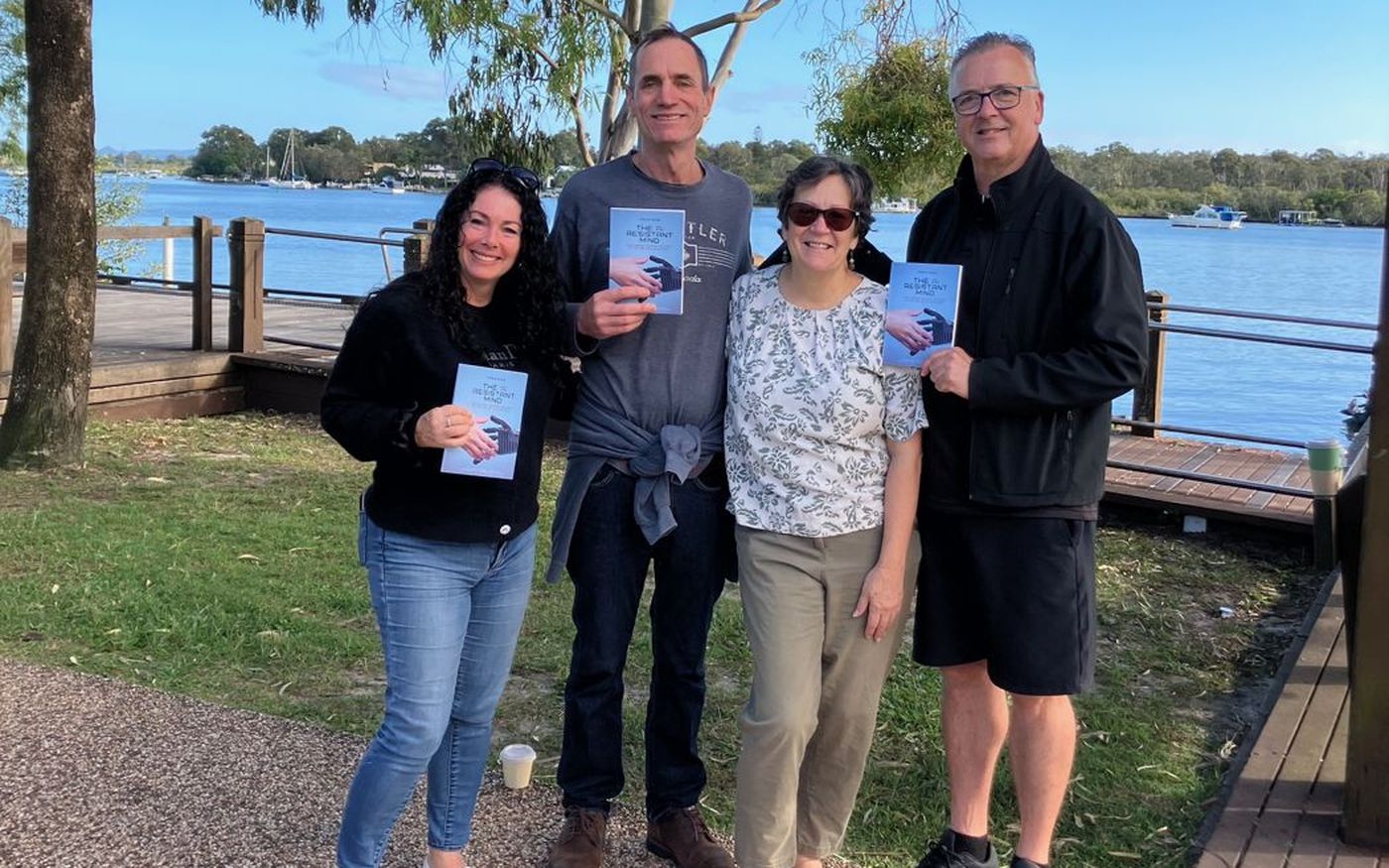
I run a Friday morning walk and talk group up here in Noosa. Every week for three years. People show up, walk a few kilometres along the river, grab a coffee, listen to one person share a bit of their wisdom. Some are still working, some are easing out, some are well into their next chapter. The thing they have in common is that they've started building a life that doesn't depend on what's on their email signature.
They've got a community. They've got something they care about. They've got a Friday morning that has nothing to do with the job. That's all I'm pointing at. Not big drama. Just starting, while you still have time, to build something that will be there for you when the work isn't.
It might be a creative practice you've been putting off. A course you've wanted to do. A community you've wanted to join. A passion you've kept quiet about for twenty years. Cassie sat on her adventure tourism dream for years before she finally started running whale swimming experiences. "People really need this," she told me. "People want this." Dr Toula had spent fifteen years quietly developing a healing method but didn't know how to share it with the world. Both started while still doing the day job. Both planted the seed.
The reality is, the dream you keep almost looking at, the thing that's been bubbling away for years, very often turns out to be the missing piece. The thing that would have given you a life regardless of what your business card said.
What questions should you sit with before next week?
Just three. Don't rush them.
- What do you do that has absolutely nothing to do with your work?
- Who are the people in your life who wouldn't disappear if the job did?
- If the title came off the door tomorrow, what would the next morning actually look like?
If those questions land hard, that's the signal. That's what brought you here. That's what the pull has been pointing at all along.
You don't have to quit. You don't have to know what your dream is yet. You just have to start asking a different set of questions. Not just "how is the job going?" but "what am I building that isn't the job?" Not just "when can I retire?" but "what am I retiring into?"
Don't end up like my dad. I mean that gently, but I do mean it. He was a good man and he lived a worthwhile life. But he never gave himself the chance to find out what else was in him, what else he might have loved, what else he might have built. You still have time.
The lab is open.